|
Places
To Visit in & Around Rishikesh
Rishikesh
Rishikesh represents the Gateway to the Himalayas in the Tehri-Garhwal
region of Uttar Pradesh. It abounds in natural splendor. The spectacle
of the Ganga rushing through the Himalayan foothills is an awesome
sight. Several temples dot the banks of the Ganga at Rishikesh.
Rishikesh is located at a height of about 1360 feet above sea level. It
is believed that several yogis and sages lived and practiced penance
here. Rishikesh represents the site where Vishnu vanquished the demon
Madhu.
Tapovan on the other bank of the Ganges houses a temple to Lakshman. It
is believed that Lakshman carried out penances here. It is also believed
that his brother Bharata meditated here, and there is a temple to
Bharata here. Also seen here are the Swargashram and the Geeta Bhawan
temples.
The Lakshman Jhula, a 450 feet long suspension bridge was built in 1939.
A newer bridge the Ram Jhula has been added recently. The Ganga abounds
in fish. Offerings of puffed rice are made to these creatures. The
freshness of the air, and sound of flowing water, the scenic beauty of
the region and the distant sound of bell chimes create an unforgettable
experience for those that visit this ancient pilgrimage town.
12 km away from Rishikesh is located the Nilkanth Mahadeo temple at a
height of about 5000 feet, commanding spectacular views of the region.
HOW TO REACH :
By Air : The nearest airport is Dehradun, 35 kms from Haridwar,
which is connected to Rishikesh by train. However, air is not the
preferred mode of transport for getting into the town. You can hire a
bus or taxi from here to reach Rishikesh.
By Rail : There is a slow shuttle train between Haridwar and
Rishikesh. Haridwar (24 km) connects Rishikesh to Kolkata, Mumbai,
Delhi, Lucknow, Varanasi, Dehradun and other cities of India by trains.
It is better to get to Haridwar by Dehradun Shatabdi and then hire a bus
or taxi to Rishikesh.
By Road : To get to Rishikesh, take the National Highway 58
passing through Modinagar, Khatauli, Muzzafarnagar, Roorkee, Haridwar
and Raiwala. Rishikesh is served by well defined road networks and is
connected by buses to other towns of Garhwal, UP and Delhi, which are
further connected to other major cities of India by road. Some important
road distances from Rishikesh are - Badrinath 301 kms. Delhi 224 kms.
Dehradun 43 kms. Kedarnath 228 kms. Gangotri 258 kms Yamunotri 288 kms.
and Uttarkashi 154 kms.
Private Vehicles : You can contact us for this, as we are well
established with an extensive number of cars and coaches (ranging from
luxury to budget and between) for the tourists from all over
Town Area
Bharat Mandir:
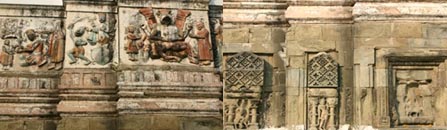 Built
by Adiguru ShankraCharya around 12th centuary, Bharat mandir is situated
in the heart of the old town on the Banks of the Ganges. Detailed
account of this oldest temple of Rishikesh is available in ancient
record of Kearkhand. The Inner sanctum of the temple has the idol of
lord Vishnu, carved out of a single Saligram. In the inner canopy above
the idol is shree yantra installed by Adiguru ShankraCharya. The
original temple was destroyed by Tamur lane in 1398 A.D. Lot of old
statues, coins, pots and other things of historical importance were
found in recent excavations in the premises of the temple. Built
by Adiguru ShankraCharya around 12th centuary, Bharat mandir is situated
in the heart of the old town on the Banks of the Ganges. Detailed
account of this oldest temple of Rishikesh is available in ancient
record of Kearkhand. The Inner sanctum of the temple has the idol of
lord Vishnu, carved out of a single Saligram. In the inner canopy above
the idol is shree yantra installed by Adiguru ShankraCharya. The
original temple was destroyed by Tamur lane in 1398 A.D. Lot of old
statues, coins, pots and other things of historical importance were
found in recent excavations in the premises of the temple.
Rishikund: Close to Triveni ghat is the most ancient place, the
rishikund. Ancient records relate this to Kubz Saint, who was blessed by
the Goddess Yamuna by saturating this pond by its water. The pond
reflects the temple of Ragunath, dedicated to lord rama and his wife.
Triveni Ghat :The main ghat in the town area where most of the pilgrims
take holy dip. Every evening hundreds of pilgrims attend the Ganga Aarti
at the Ghat.
Ram Jhula Area
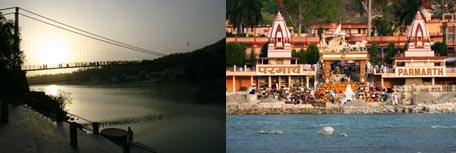 Geeta
Bhawan :One of the oldest temple complex in the area. The famous Indian
epic Ramayana and Mahabharta are described here on the walls. Geeta
Bhawan :One of the oldest temple complex in the area. The famous Indian
epic Ramayana and Mahabharta are described here on the walls.
Parmarth Niketan:
One of the most renowned temple complex and ashram in the area . Known
for its substantial work on Hinduism, three is a school run on
tradtional Indian Patterns. The ashram organizes excellent Ganga Arti
and Hawan on the Parmarth Ghat every evening.
"When global orange sun suspended, waits low amid the red/yellow
streaked horizon, then all these combine to give this town a very
special evening. The temple bells roar, priests enchant mantras.
Immersed in sublimation stand the pilgrims . Cupped leaves, with saffron
marigold petals and a small candle flame, flickering ride the current of
water of wisdom. Suddenly the sky darkens , spreading a blanket of
stillness. Everything stops, except the sound of current , which has
just sunk the tiny flames of cupped leaves, few minutes back".
Transcendental Centre of Maharishi Mahesh Yogi: Situated on the extreme
end of Geeta Bhawan area , Marishi's TM centre is situated in the
pecaeful forest area. Once the most active branch has nothing much to
offer to the visitors today. One can see the ruins of the TM centre from
a distance.
Laxman Jhula Area
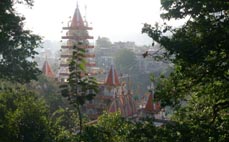 Tera
Manzil Temple :A multistory temple complex of idols of hindu Gods, and
Goddesses. Very popular among the domestic pilgrims. One can have an
excellent view of the entire area from the top floor of the temple
complex. Sunset view from this place in winters is a excellent option. Tera
Manzil Temple :A multistory temple complex of idols of hindu Gods, and
Goddesses. Very popular among the domestic pilgrims. One can have an
excellent view of the entire area from the top floor of the temple
complex. Sunset view from this place in winters is a excellent option.
Laxman Temple:
On the right bank of the Ganges is situated the ancient temple of
Laxman. Lord Rama with Laxman made a twig bridge here on the way to
their journey to high Himalayas.
Outskirts of Rishikesh
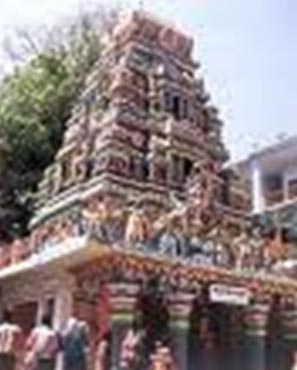 NEELKANTH
TEMPLE NEELKANTH
TEMPLE
Neelkanth temple is one of the most revered holy place of worship for
the Hindus. It is located on a hill above Swargashram in Rishikesh and
is situated at a height of 926 meters. Neelkanth temple is considered to
be a sweet example of complete natural hill heaven that lies adjacent to
mountain ranges of the Nar-Narayan. Because of its beauty & religious
importance the devotees and nature lovers throng the place all round the
year. Neelkanth Mahadev temple is considered to be one of the most
famous temples and is situated at the confluence of the Madhumati and
Pankaja rivers, about 32 kms from Rishikesh, amidst three valleys-
Vishnukoot, Brahmakoot & Manikoot. There are several temples at every
fold of the Himalayan range & Hindu mythology is closely associated with
most of these temples.
Way to the temple:
The way to the temple is quite exhilarating. The steep & narrow roads
taking above the hill, in which the river is flowing on one side and
mountain terrain is on the other side. A drive of 32 kms from Rishikesh
via barrage or an alternate route of 22 kms via Ram Jhula can get you
there with ease.
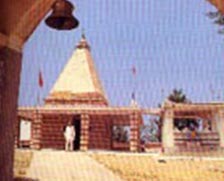 KUNJAPURI
TEMPLE - SUN RISE OR SUN SET KUNJAPURI
TEMPLE - SUN RISE OR SUN SET
Drive to Kunja Puri, one of the thitrteen most important Goddesses of
Shivalik range , the lower Himalayas. One can witness excellent sunrise
or sun set on the Greater Hiamalayan Peaks and the vast Indo Gangetic
plains . One can see almost all the peaks of Garhwal Himalayas from here
e.g. Banderpunch (6316 Mts) , Swarga Rohini (6252 Mts) Gangotri ( 6672
mts) Chaukhamba (7138 mts) etc.
Surkanda Devi ( 10,000 Feet)
Drive ( 2.5 to 3 hrs) to Kaddukhal via Narender Nagar, the capital of
Tehri-Garhwal once. Now the palace is converted in to a world famous
Spa. We stop at the palace for come time and continue to Chamba. The
entire drive till chamba is gradual ascent through the forest and small
villages. We stop at the small hill town of Chamba for a cup of tea and
then drive along the ridge till Kaddukhal. One can enjoy the panoramic
view of mountains on one side and the big Doon Valley on the other side.
Arrive Kaddukhal and Commence trek (1.5 hrs) to Surkanda Devi. The
entire trek is gradual ascent till the mountain top. Visit the temple of
Surkanda Devi , one of the 13 important Goddesss of Himalayan Foot
hills.
Enjoy the 180 degrees panoramic view of snow covered Greater Himalayan
Range and the massive Doon Valley. One can see almost all the Major
peaks of Garhwal Himalayas e.g Swarga Rohini 6252 Mts Sudarshan parbat
(6507 Mts), Kamet (7756 Mts), Nanda Gunti (6309 Mts.), Nanda Devi (7878
Mts.) etc.
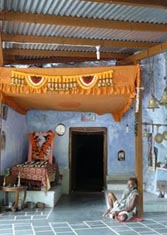
Trek down ( 01 hr) to Kaddu Khal. Picnic Lunch and little rest in the
mountain tea shops. Later drive back to Rishkesh via Mussorie ( The
famous hill station in north India) and Dehradun , the capital of
Uttaranchal State.
Instead of driving via Mussoire , One Can also opt for visit to Tehri
Dam lake near Chamba.
VASISHTHA GOOFA:
One hour drive from Rishikesh up river is situated Vasishtha Goofa ,
where famous saint Vasishtha meditated on the banks of the Ganges. The
cave is very peaceful and is a perfect place for meditation.
The entire drive to Vasishtha Goofa is along the river.
Devprayag :
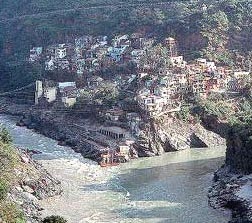 One
of the Panchprayags ( Five confluences), Devprayag is an ancient town
situated at the confluence of Alaknanda & Bhagirathi, where river making
the holy Ganges. Visit the ancient temple of Lord Rama at the beginning
of the holy Ganges. One
of the Panchprayags ( Five confluences), Devprayag is an ancient town
situated at the confluence of Alaknanda & Bhagirathi, where river making
the holy Ganges. Visit the ancient temple of Lord Rama at the beginning
of the holy Ganges.
The entire drive is along the beautiful river Ganga up to Devprayag.
Raja Ji National Park
Raja Ji National Park is one of the biggest parks in north India
situated at the meeting point of Himalayan foothills and Indo Gangetic
plains, the venue for migratory birds from world over. The core zone &
one of the main gates of the national park is Chilla. Chilla is 17 kms
from Rishikesh on the east western side.
Rajaji is one of northern India’s major wildlife reserves and the best
places to see the fauna and flora of the terai region and spread over an
area of 820.42 sq km. The park named after the great freedom fighter
Late Sri C. Rajgopalachari; popularly known as "Rajaji" was created
after joining the three sanctuaries in the Western UP, Shivaliks -
Rajaji, Motichur and Chilla into a large protected area in the year
1983. Rajaji National Park is distinct for its pristine scenic beauty
and rich bio-diversity and it’s a paradise for nature lovers and
wildlife enthusiasts, the ecosystem of the park is adorned with
Elephants, Tigers, Leopards, Deer and Ghorals as its best known life
forms. Rajaji Park is the best place to see 23 mammal’s species and 315
species of bird including pea fowl, woodpeckers, pheasants, kingfishers
and barbets, supplemented by a number of migratory species during the
winter months.
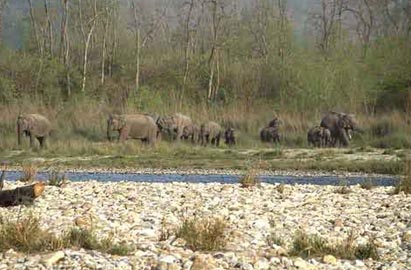 Rajaji
is a magnificient ecosystem nestled in the Shivalik ranges and the
beginning of the vast Indo–Gangetic plains, thus representing vegetation
of several distinct zones and forest types like sal forests, riverine
forests, board–leaved mixed forests, scrubland and grassy. Rajaji
is a magnificient ecosystem nestled in the Shivalik ranges and the
beginning of the vast Indo–Gangetic plains, thus representing vegetation
of several distinct zones and forest types like sal forests, riverine
forests, board–leaved mixed forests, scrubland and grassy.
Rajaji National Park is situated along the hills and foothills of
Shivalik ranges in the Himalayan foothills and represents the Shivalik
eco-system
|